
Imagine living with back pain for 20 years and finally being able to move, exercise, and go about your day without constantly thinking about your back. Imagine feeling physically capable of doing the things you enjoyed 20 years ago. For many people living with chronic back pain, that seems almost impossible.
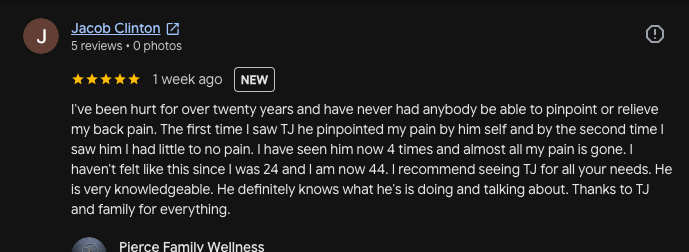
A recent Google review for Pierce Family Wellness describes exactly that experience. After living with back pain for more than 20 years, the reviewer reported experiencing little to no pain after his second appointment and almost complete relief after four sessions. At 44 years old, he described feeling better than he had since he was 24.
While everyone’s experience is different, this raises an important question: Why do some people continue to experience pain despite years of massage therapy, stretching, strengthening, and other interventions?
Part of the answer may lie in how well we understand human anatomy and, more importantly, how we apply that knowledge.
Understanding Anatomy Can Change the Way You Experience Pain
There is a significant difference between knowing anatomy and understanding anatomy. Memorizing the origins and insertions of muscles is one thing. Understanding how those muscles interact with the joints, fascia, nervous system, and surrounding anatomical structures during movement is something entirely different.
The human body does not operate as a collection of independent parts. Every time you walk, bend over, swing a golf club, or pick up your grandchildren, thousands of anatomical structures work together to produce and control movement.
When one area loses mobility or the ability to effectively manage mechanical stress, other areas may compensate. Over time, those compensations can change how forces are distributed throughout the body, potentially contributing to discomfort, stiffness, and limitations in movement.
Understanding these relationships allows us to look beyond where someone experiences pain and investigate what may be contributing to it.
Why the Location of Your Back Pain May Not Tell the Whole Story
One of the biggest mistakes people make when trying to overcome chronic back pain is assuming that the location of their pain is necessarily the location of the underlying problem.
Consider someone who has lost mobility in their hips. Every time that person bends over, rotates, or performs certain exercises, their lumbar spine may compensate for movement that would otherwise occur at the hips. Over thousands of repetitions, this can increase the mechanical demands placed on the lower back.
Massaging the muscles of the lower back may provide temporary relief. Strengthening the abdominal muscles may improve stability. However, if restricted hip mobility is contributing to the problem and remains unaddressed, the original movement pattern may continue.
This is why understanding the anatomical relationships between the hips, pelvis, spine, and surrounding fascial structures is so important. It allows us to make more informed decisions about where to focus our efforts rather than simply chasing symptoms.
How Anatomy-Based Massage Therapy Can Help You Move Better
Massage therapy becomes a much more targeted tool when it is guided by a comprehensive understanding of anatomy and biomechanics.
Rather than simply massaging muscles that feel tight, we can consider why those muscles may be tight in the first place. Is the muscle compensating for a lack of stability somewhere else? Is restricted joint mobility changing its mechanical demands? Is the nervous system increasing muscular tension as a protective response?
These questions influence how we approach massage therapy at Pierce Family Wellness.
Sometimes the objective is to reduce muscular tension. Other times, it is to improve movement tolerance, reduce sensitivity, or create an opportunity for someone to move more comfortably.
The real value of massage therapy is not simply how relaxed you feel when you get off the table. It is how that session translates into your ability to move, exercise, sleep, and participate in the activities that make your life enjoyable.
Why the Right Exercises Can Make a Difference
Exercise is one of the most valuable tools we have for improving physical function and managing chronic musculoskeletal pain. However, exercising more is not necessarily the same as exercising more effectively.
Imagine taking your car to a mechanic because the tires are wearing unevenly. You could replace the tires every few months, but if the alignment is contributing to the problem, you may continue experiencing the same issue.
Exercise can be similar. Strengthening muscles without considering joint mobility, coordination, and the distribution of mechanical forces may overlook important factors contributing to someone’s discomfort.
At Pierce Family Wellness, we use individualized exercise techniques, including ELDOA, myofascial stretching, segmental strengthening, and proprioceptive training, to address specific movement needs.
The objective is not simply to make someone stronger or more flexible. It is to help them develop the physical capacity to return to the activities they enjoy with greater comfort and confidence.
Research published in the Cochrane Database of Systematic Reviews supports exercise therapy as an effective option for managing chronic low back pain, although individual responses vary.
Combining Massage Therapy and Exercise for Longer-Lasting Results
Massage therapy and exercise are often viewed as two separate services. I believe some of their greatest value comes from understanding how they can complement one another.
Massage therapy may help reduce discomfort and improve movement tolerance, creating an opportunity to introduce exercises that were previously difficult or uncomfortable. Exercise can then help develop the strength, mobility, coordination, and tissue capacity necessary to support those movements over time.
The World Health Organization’s guidelines for chronic primary low back pain recognize both structured exercise and massage as potential components of an individualized approach to managing chronic low back pain.
Rather than relying exclusively on passive interventions, combining massage therapy with appropriate exercise gives people an opportunity to become active participants in improving their physical function.
The ultimate goal is to help people become more physically independent, not more dependent on appointments.
What Would Your Life Look Like Without Constant Back Pain?
For someone who has experienced chronic back pain for 20 years, the most meaningful outcome is rarely an improvement in flexibility measurements or an increase in muscular strength. Those things may be important, but they are not necessarily what that person wants most.
They want to wake up without dreading getting out of bed. They want to travel without worrying about sitting on an airplane. They want to ski, golf, hike, exercise, and spend time with their families without constantly modifying their lives around their backs.
That is why I believe understanding anatomy is about much more than understanding muscles, joints, and fascia. It is about understanding how those structures influence someone’s ability to live the life they want.
Pain is complex, and not every case can be explained by anatomy or biomechanics alone. However, a comprehensive understanding of the body, combined with an individualized approach to massage therapy and exercise, can help identify opportunities for improvement that may have previously been overlooked.
At Pierce Family Wellness in Centennial, Colorado, our goal is not simply to help you feel better during your appointment. It is to help you move better, feel better, and stay active for life.
If chronic back pain has been limiting your ability to enjoy the activities you love, schedule an individualized assessment at Pierce Family Wellness and discover a different approach to improving your movement and physical function.
TJ Pierce BS Exercise Science, LMT
