
Most people think improving flexibility means stretching a tight muscle. If your hamstrings feel tight, you stretch your hamstrings. If your hips feel stiff, you stretch your hip flexors. And while those exercises can be extremely beneficial, there’s another approach to improving mobility that I think gets overlooked.
Instead of stretching one muscle or even one muscle group at a time, what happens when we start moving through the larger fascial lines and patterns of the body?
Think about how you actually move throughout the day. When you walk, your foot hits the ground, your hip moves, your pelvis rotates, your spine responds, and your opposite arm swings. All of these movements have to coordinate with one another. Your body doesn’t function as a collection of isolated muscles. It functions as an interconnected movement system.
That’s why I like incorporating athletic dynamic mobility exercises into my clients’ programs. They give us an opportunity to work on flexibility while simultaneously challenging balance, coordination, muscular control, and even cardiovascular conditioning.
And you don’t have to be an athlete to benefit from them.
What Are Dynamic Mobility Exercises?
Dynamic mobility exercises involve moving your body through controlled ranges of motion rather than simply moving into a stretch and holding that position. They often involve multiple joints moving together, requiring your nervous system to coordinate different areas of your body simultaneously.
There’s an important distinction between flexibility and mobility. Flexibility generally describes how much range of motion is available, while mobility includes your ability to actively move through and control that range.
For example, you might be able to lie on your back and pull your knee toward your chest with your hands. But can you actively lift that same knee while standing on one leg without losing your balance or compensating somewhere else?
Those are two different abilities. Neither is necessarily more important than the other. They simply tell us different things about how your body moves.
Dynamic mobility exercises help bridge that gap by combining available range of motion with active movement and control.
Understanding Fascial Lines and Why They Matter
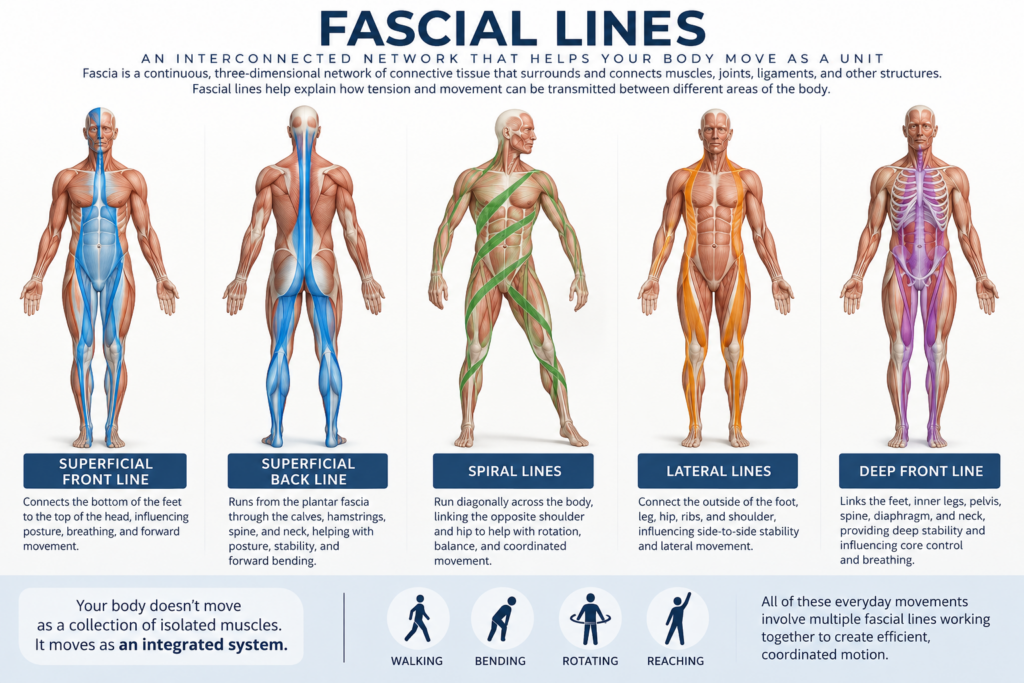
Fascia is connective tissue that surrounds, supports, and connects structures throughout your body. It forms a continuous three-dimensional network associated with muscles, tendons, ligaments, nerves, and other tissues.
When we talk about fascial lines, we’re describing anatomical and functional relationships between different regions of this connective tissue network. These connections help us understand how tension and mechanical forces may be transmitted between different parts of the body.
For example, consider the relationship between your foot, calf, hamstrings, pelvis, and back. These structures don’t operate independently when you bend forward, walk, or run. They work together as part of a larger mechanical system.
Research has investigated these relationships, including a systematic review examining the anatomical evidence for myofascial chains. While the findings support the existence of certain connective tissue continuities, the evidence varies between proposed fascial lines, and anatomical continuity doesn’t necessarily mean every movement loads an entire line equally.
This is where global stretching becomes interesting.
Rather than focusing exclusively on one muscle, we can use movements that involve several connected regions simultaneously. As we move through different positions, we’re asking muscles, joints, connective tissues, and the nervous system to coordinate across larger movement patterns.
That’s much closer to how we use our bodies in everyday life.
Why Specific Myofascial Stretching Still Matters
I use a considerable amount of specific myofascial stretching and segmental stretching in my practice. In fact, some of the most valuable exercises I teach are designed to influence a particular muscle, muscle group, or specific region of connective tissue.
There are times when specificity is exactly what we need.
If I’m working with someone who has limited mobility around a particular joint, I may want to be very precise about the position, direction of tension, and structures we’re attempting to influence.
But there are also times when I want to do almost the opposite.
Instead of getting more specific, I want to go global.
I want to see how well someone can coordinate multiple joints, shift their center of gravity, rotate, maintain balance, and move through larger patterns.
That’s where athletic dynamic mobility exercises fit into the program.
The two approaches complement one another. Specific stretching helps us focus on particular limitations, while global movement gives us an opportunity to integrate mobility into more complex activities.
If you’d like to understand more about the connective tissue system we’re working with, I’ve written another article explaining what fascia is and why training your fascia matters.
Dynamic Mobility Challenges More Than Just Your Muscles
One of the things I like about dynamic mobility exercises is that we’re not simply asking the body to become more flexible. We’re asking it to use that flexibility while performing coordinated movements.
Think about something as simple as reaching down to pick something up while standing on one leg. Your hip has to move, your pelvis has to adjust, your spine has to respond, and your nervous system has to continually make corrections to keep you balanced.
Now add rotation or a change in direction.
Suddenly, you’re challenging multiple physical qualities at the same time.
Your visual system, vestibular system, and proprioceptive system are continually providing information about where your body is in space. Your nervous system uses that information to coordinate muscular activity and maintain your balance.
This is one reason I think dynamic mobility exercises can be particularly valuable as we get older. We don’t just need enough flexibility to get into a position. We need to maintain the ability to control our bodies as we move through different positions.
That requires practice.
Why Global Fascial Stretching Can Complement Your Training
When we perform a specific myofascial stretch, we’re generally trying to influence a particular structure or region. With global stretching, we’re organizing movement across several regions simultaneously.
Think about the difference between practicing a single musical note and playing an entire song.
Both require skill, but playing the song requires you to coordinate several things at once.
Movement works in a similar way.
Your muscles, joints, connective tissues, and nervous system have to coordinate to produce useful movement. Training individual components can be beneficial, but eventually those components have to work together.
Research has also examined force transmission between muscles along myofascial chains. These findings offer a biomechanical basis for considering relationships between connected tissues, although they don’t establish that stretching an entire fascial line produces superior outcomes compared with more specific stretching.
Global dynamic mobility exercises give us an opportunity to practice movement integration.
They also allow us to explore movement in different planes. Instead of only moving forward and backward, we can incorporate lateral movement, rotation, and combinations of several directions.
That’s important because everyday activities rarely happen in just one plane of motion.
Walking, reaching, turning, stepping around obstacles, playing golf, gardening, and getting down onto the floor all require different combinations of movement.
The more comfortable and capable we become moving through those patterns, the more options we have when navigating everyday life.
Why I Like Dynamic Mobility as Part of a Warm-Up
I particularly like using dynamic mobility exercises at the beginning of a workout.
Rather than immediately moving into heavy resistance training or vigorous activity, we can progressively prepare the body by moving through controlled ranges of motion.
As the movements become more continuous, muscular activity increases, body temperature rises, and the cardiovascular system begins responding to the increased demand.
At the same time, we’re rehearsing movement patterns that may be useful during the workout itself.
This doesn’t mean dynamic mobility replaces strength training, cardiovascular exercise, or specific flexibility work. It means we can use a relatively short period of time to prepare several physical systems simultaneously.
And for someone who doesn’t have an hour to spend stretching before every workout, that can be particularly useful.
The important thing is to keep the movements controlled. Dynamic doesn’t necessarily mean fast, and it certainly doesn’t mean forcing yourself into ranges of motion you can’t comfortably manage.
The Difference Between Being Flexible and Moving Well
After more than 20 years working with movement, one of the things I’ve come to appreciate is that having more range of motion doesn’t automatically mean someone moves better.
You also need the strength, coordination, balance, and control to use that range.
I’ve worked with people who are extremely flexible but struggle to stabilize certain joints. I’ve also worked with people who have relatively limited flexibility but move exceptionally well within the ranges available to them.
That’s why I don’t believe we should look at stretching as a single method with one objective.
Specific myofascial stretching, segmental stretching, ELDOA, dynamic mobility, and strengthening all have different applications.
Sometimes we need to be very precise about a particular joint or tissue. Other times, we need to bring everything together and challenge the body as an integrated system.
Neither approach replaces the other.
Putting Dynamic Mobility Into Practice
In the accompanying video, I demonstrate several athletic dynamic mobility exercises that challenge different fascial patterns while incorporating flexibility, balance, coordination, and active movement.
The goal isn’t to see how far you can stretch or how quickly you can move. It’s to explore the ranges of motion available to you while maintaining control of your body.
Start with movements you can comfortably manage, and gradually increase the range as you warm up.
If you’re interested in developing a more individualized approach, you can learn more about our mobility and flexibility training at Pierce Family Wellness.
Ultimately, that’s what matters to me.
Not just how far you can stretch, but how well you can move.
At Pierce Family Wellness in Centennial, Colorado, we combine individualized movement assessments, personal training, myofascial stretching, ELDOA, and massage therapy to help people improve their movement and stay active throughout life.
Move Better. Feel Better. Stay Active for Life.
